My first job was working for the State of Oklahoma's Government Information Service. I got asked a number of interesting questions. One, in particular, sticks in my mind today. I will do my best to recreate the conversation as faithfully as I can:
Caller: Do you know that the Confederate flag is flying over the State Capitol?
Me: Yes, Ma'am, (reaching for a brochure I have on my desk) it's part of the Fourteen Flags Plaza.*
Caller: I don't think that's right...
Me: Ma'am, the plaza's there to show the fourteen flags which flew over Oklahoma prior to statehood. The Confederate flag is just one of them...
Caller: Do you think that's right?
Me: Ma'am, I can't give my opinion...
Caller: But, do you think that's right?
Me: If you're asking me if I approved of slavery, my answer is no. If you're asking me if I believe we should display our history, I'd want to remind you about some of the other nations whose flags are flying in the plaza. The Cherokees, for example, had slaves. The Spanish had the Inquisition. The French royalty treated their peasants so badly....
Caller: I think they should remove the Confederate flag.
Me: Ma'am, if you believe that, you should talk to your State Representative and Senator. The state's certainly spending money to keep them up and you could make suggestions for that money's alternate use....
I've never been one to shirk the unpleasant aspects of history. I liked to think we'd come a long way. After Wednesday's shooting of nine Black congregants during a Bible study, I'm not so sure we have.
No, I emphatically do not believe this was an attack on Christianity. The shooter's words before he started killing people were: “I have to do it. You’re raping our women and taking over the country. You have to go.”
http://c.o0bg.com/rf/image_960w/Boston/2011-2020/2015/06/18/BostonGlobe.com/EditorialOpinion/Images/0622CHARLESTON.jpg
The Confederate flag, which the attacker firmly embraced, is not just a reminder of our dark and ugly past to some. In the attacker's eyes, it's a rally to race war.
And it's time to take every one of them down.
"Like the Nazi flag, the Confederate battle flag has come to symbolize to
large portions of the public extremely destructive attempts to promote
racism. And in both cases, extremists use them as the potent symbols of
racism they are in order to rally like minded extremists. As such, it
does not deserve to be flown over any public building in these United
States." David Kinne
Please note the Fourteen Flags display was removed from the Oklahoma Capitol grounds in 1988. The Oklahoma State Fairgrounds still has the Fourteen Flags Plaza, which shows the fourteen flags:
http://newsok.com/14-flags-plaza-shows-state-history/article/2551499
Rebecca McFarland Kyle, June 2015
Friday, June 19, 2015

Wednesday, May 20, 2015
COMMENTARY: Sansa Stark Rape --- GET REAL
Monday morning, the internet was all abuzz over the Sansa Stark rape scene on Game of Thrones. I honestly can't remember this much buzz about a program since the cliffhanger on Dallas.
I admit it, I was surprised.
Every single show starts out with a MA warning. And we've needed it. The rape scene was by far not the worst thing I have seen....I read the books and the "red wedding" had me shaking for quite a while after that.
And, of course, there's far more violence I could mention....That brought me to several solid conclusions:
ONE: People are often immune to violence. I've always been acutely aware of the effect of television violence. Studies on children show that watching violent programs desensitizes children to violence and could lead to more violent behavior. Further, in adults it can also lead to a disproportionate sense of unease about society.
Essentially, if you are what you eat, you also often are what you "consume" via the media.
"You are the only censor if you don't like what I say you have a choice you can turn me off."
Alice Cooper -- Lay Down and Die, Goodbye
TWO: People don't complain effectively. Oh, they'll complain loud and long--on the Facebook page of a relative stranger...But do they actually go to the right place? When I suggested to a vitriolic complainant that they should perhaps write their treatise on violence in Game of Thrones to HBO or George RR Martin, the author of the novels, they were outraged. I pointed out there was no point posting it at some random person's page -- when the people making the decisions about future violence would probably not read it.
THREE: People need to get real here. Where is the outrage about real rape cases? I can name four serious situations that I have come across in the news in the last day and I don't see as much discussion and outrage about them as there seems to be about a fictional character.
Here goes:
Rape's more prevalent than you think. A study of one college showed 18% of the freshmen girls either were raped or had an attempted rape. Just in one year:
https://www.insidehighered.com/quicktakes/2015/05/20/study-prevalence-rape-first-year-students#.VVyZQVr6uOM.facebook
"Affluenza" is real. If this was a poor man, particularly a minority, he'd be in jail for much longer. You think this is going to stop Mr. Johnson from inappropriate behavior in the future?
Samuel Curtis Johnson III, the billionaire heir to the SC Johnson fortune confessed to repeatedly raping his twelve-year-old step-daughter and what kind of sentence does he get: four months and a a $6,000 fine.
http://www.addictinginfo.org/2014/06/07/billionaire-gets-off/
Judges don't take child rape seriously. The rapist of a three-year-old got a light sentence because his attack on the child "wasn't violent."
http://edgytruth.com/2015/04/10/judge-gives-light-sentence-to-child-rapist-claiming-sodomy-wasnt-violent-click-here-do-something/#
And a Baptist pastor got by with raping a mentally challenged twenty-year-old girl in Louisiana because the girl didn't know to fight him off?
http://www.dailymail.co.uk/news/article-2572006/Baptist-pastor-arrested-police-claim-mentally-handicapped-womans-father-sex-wife-bedridden.html
GET REAL, HERE!
So, what can you do?
First of all, talk to the right people. Get in touch with your elected officials and tell them you want stronger laws and sentencing against rapists and child abusers.
Second, get in there and help. Contact your local Rape Crisis Center or Women's Shelter and donate your items, money, or time to them. Literally, abuse victims can come in to the shelter with nothing more than the clothes on their backs -- these are real people in need of real help. If you've got outrage for these situations, spend it wisely.
Rebecca McFarland Kyle, May 2015
Sunday, May 17, 2015
The Un-Civil War Or My Faux News Family
Futurist and Science Fiction author, David Brin, states the United
States is in their third Civil War. There's nothing "civil" about the
political divide currently in the United States. I know far too many
people who've lost friends, even family over the difference of a single
opinion.
I've lost two family members, so far.
1. Cousin V went from a moderate to a neo-con with the turn of the 2008 election. I knew her physicist husband voted for Obama. We had pretty honest discussions about politics. He said he was going to since he'd done his research and noted that Democrats restore the economy and reduce the deficit where Republicans do not. We definitely needed some recovery badly in 2008.
That's when the emails started. Understand V has a Masters degree in Accounting and she knows the value of research. She obviously didn't do any when the emails agreed with her prejudices.
I snopes pretty much everything that comes in my email. I sent her corrections, which she ignored.
Seeing as she felt free to fill my inbox with her prejudices, I sent something to her regarding a statement of Glen Beck's which I disagreed with.
Her response: "You are too liberal to be friends with anymore."
Friends? We were family before that.
T, her husband, who was quite ill at the time with brain lesions, understood my reasoning precisely and said that he and I could continue talking via another email. So, I continued to send emails to him, but never got an answer. He wondered why I wasn't corresponding. I advised him that I was. When I asked if V had access to the emails, he said "no."
I continued to send get well cards to him, a couple a month, and I sent a sympathy card when he passed. I hope he got the cards. I spent time and money trying to make sure he knew someone cared about him and was hoping the best. I never knew whether she gave them to him or not. That's on her. I tried. V. never contacted me except once more.
She sent a completely fictitious email about President Obama. I didn't bother to Snopes it. At that point, I figured I was off her list anyway. Then, someone else on the list did fact-check and sent the correct information via REPLY ALL.
Her response: "I guess I wanted it to be true so I didn't bother to look it up...."
2. I knew Uncle H was a racist since I was six or seven. I remember a long ride back from my grandparents with him and my Mom back in the Sixties where he ranted about Dr. Martin Luther King and H. Rap Brown and wished both of them would get shot. He used language my mom said I should never use, but she never corrected her little brother and when I asked she said, "He's a grown man, honey, I'm not going to change him...You know better."
I don't remember exchanging more than cursory conversation with the man. He talked to my Mom. If I answered the phone, he'd ask for her and I'd get her. He was busy and I got the feeling he didn't want to deal with someone else's kid, even if it was a niece.
The emails started shortly after the election. I'm not sure how Uncle H even got my email. I can't say I'd send a thank you note to whoever provided it.
I snopesed and sent him the correct information. For that matter, I even tried to engage him in conversation asking how his family was, etc. He never replied. He just kept filling my email with stuff he hadn't bothered to research which -- from my sampling--was lies.
I finally emailed and said, "Look, if you want to talk about your family, about your experiences, etc., I'd be glad to listen. I'm not interested in politics, particularly if you are not going to do any kind of research..."
Half a dozen emails of the same ilk as before the next day. I set his email on "JUNK" and walked away.
It disturbed my Aunt J (his younger sister) that I'd done this. I advised her, he wasn't sending anything personal to me.
"He's my baby brother and he's just always been kind of a brat," she said. I wondered then if his older sisters had called him on it if he'd have been so much of a brat. I don't know. I could have asked Mom that or just about anything, but Aunt J was not in a state I could do that.
Nothing he'd even written, just forwarding garbage. Still it made her cry and I felt sorry I'd admitted it. I did check the email at that time. Same old junk. Sadly, he sent the same email to me at least three times in some instances. I was just on a SPAM list.
3. Cousin G is someone I admire very much. Okay, maybe not her research skills or her paranoia, but she walks the walk of her faith. She's served as a church organist, a Hospice Chaplain, and volunteer and done more work to help the needy than many folks I know.
The same emails started after the election. Heck, she even started her Christmas cards with:
"I'm disappointed in the election...."
Yes, she believes every wrong word she hears about President Obama and the government. Sadly, she's let racist language slip, too.
The difference is, she actually reads the research I do and thanks me for part of it. We're still friends and I think occasionally what I say to her makes a difference. She actually asks me questions sometimes and I do my best to research them and show her my work so she knows that I actually am not just spouting an unfounded opinion.
And -- I have told her what my Mom thought about a lot of issues. She always respected Mom as a well-educated and a thinking person and when she hears what Mom used to say to me back -- fifty plus years ago growing up some of her anger goes away.
Yeah, I hate that we're dealing with the same issues and the same racism and hatred we dealt with when I was growing up. I have my Mom to thank for me growing up as a thinking person who does their research and believes in equality and justice.
The one difference between Mom and me is that I am speaking out to my elders--her peer group--and saying what I think. Uppity, I suppose so, but do we change the world by being silent? Sometimes we have to do it by presenting facts and not allowing people to just be "bratty" or "difficult."
R. M. Kyle, May 2015
Wednesday, April 29, 2015
Fifty Shades of "Nay"
I do my best to keep in touch with my ninety year old aunt. She prefers "Auntie Mame" to her given name because she's a huge fan of the musical and it's her ambition to enliven the lives of the people she cares for, too.
Auntie M: Have you read this new book, Fifty Shades of Grey?
Me: I only got through a few pages...the writing was terrible
Auntie M: It's pretty sexy...
(I have to stop and take a breath here. Yeah, my aunt's been married three times, but she's ninety)
Me: You're okay with that?
Auntie M: No, not really...but the books were given to me by X...
(X is her daughter-in-law, the recent widow of her only son. She takes good care of Auntie M but I don't believe she would want my aunt to be uncomfortable or unhappy)
Me: You don't have to read every book that's given...
Auntie M: But she says it's really good...
Me: Good is a matter of taste--not everyone has to like the same things...
Auntie M: She and her girlfriend are going to take me out to dinner and the movies and we're going to see the film...
Me: You want to see it?
Auntie M: (pause) .... no
Me: (gets out phone and looks up the Rotten Tomatoes rating for Fifty Shades of Grey.) It only got 25 on Rotten Tomatoes. That's not very good.
Auntie M: I liked that movie...
Me: Huh?
Auntie M: The one about fried green tomatoes...
Me: No, Auntie, Rotten Tomatoes is a rating group for movies. The rating's from zero to 100 with 100 being the best. Fifty Shades of Grey got a 25.
Auntie M: It didn't deserve that much from what I'm reading...
Me: If you don't want to finish the book...
Auntie M: I've got the other two, they lent them to me...
Me: You don't have to read stuff you don't like. It's not like there's going to be quiz or something...
Auntie M: But we're going to dinner and to the movie...
Me: (looking at listings) There are several other films you could suggest to see instead. (I list them and tell her about them..)
Auntie M: Maybe the weather will turn bad...
Me: Why not just suggest another film? Auntie M, if you're not comfortable reading the book, you're not going to like the movie much better....
Auntie M: Maybe I'll get sick....
Me: Maybe you'll just say "No thanks, let's go see another movie. That's what the girl should have said in the book...."
Auntie M: It looks like snow....
Me: The forecast would be better if it looked like NO!
No is a two-letter word, which is easy to say when we're two years old. It gets harder as we age. We don't want to be perceived as negative or fun-haters. We want to fit in.
Too many women are taught to please, to make the people we love happy without thought to our own happiness, let alone just plain comfort.
The best thing we can learn to do is say, "No thank you," and make an alternate suggestion if there's something else we want to do.
R. Kyle, April 2015
Tuesday, November 12, 2013
REVIEW: Dissected -- Megan Messina Bostic
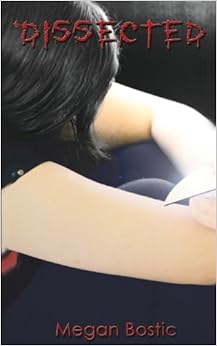
When Sydney Warner was six, she awoke one day to find her Mom's telescope and jewelry left in her room. Her Mom was gone--the note she left read she was going to be happy. Sydney managed to weather that storm well enough, but in her junior year far worse happened--and she went badly off-course. Syd's begun to cut herself. Her father and teachers don't know--and if they don't find out, she could cut too deeply.
Sydney's story is told with empathy and concern. Ms. Bostic did her research and made sure her fictional character went through a factual journey. The story's believable, heartfelt, and strongly written.
Some authors would shy away from the hard topics, but Megan Bostic knows that there are kids out there going through difficult situations like Sydney's. Is this a real condition? The new DSM includes a new condition listed called NSSI or Non-Suicidal Self Injury. It's estimated that one in five young girls today cut themselves with razor blades or burn themselves with fire. That's a dramatic increase from 3% of the population in 1990. This condition is particularly common among young girls from ten to sixteen. It's theorized they do this to trigger a flow of endogenous opiates into their bloodstream--these chemicals help deal with pain. Girls who are doing this are not acting out--they do not want parents or teachers to find out. Most conceal their condition with long sleeves or long pants.
Reading books like these help young adults to know that they are not alone. Perhaps that's not as good as group therapy, but it's an important start. How do I know this? Go Ask Alice stopped me from taking drugs in when I was in the eighth grade.
This book is absolutely recommended for readers of all ages. Sydney is a strong likeable character and her predicament is riveting. The plotting is so good you will want to read into the night.
SOURCE: ARC provided by the author
Rebecca McFarland Kyle, November 2013
Friday, May 3, 2013
BOOK REVIEW: The Possibility Dogs
Those of you who know me know that I am legally blind. I was born with cataracts and have had deteriorating vision ever since. At some point, I will need a service dog. My eye doctor made the suggestion last year and I just have not had the courage to follow through yet.
I've been told that a service dog would grant me better access and I would be more approachable than I am carrying my cane. The one friend I asked about this said: "I'd be more interested in the dog than the person with it."
Was it her? Is this everyone? I would like to think not, but that gave me pause.
My lifelong dream has been to work with dogs in some way to do service work. I've never been in a position to be a puppy breeder as I once hoped, but I'm wondering if organizations are going to stop using purebreds and start taking shelter dogs.
Why? Not every puppy--even those from a solid lineage, makes the cut for service work. From birth, dogs bred for service work, are socialized and trained. Then they go to a puppy raiser who works with them for months before they ever reach the training facility for service dogs.
And there is a greater need for service dogs now, particularly with our soldiers coming back from Afghanistan with PTSD.Many organizations have applicant waiting lists that are literally years long.
But--some groups are going a more direct route. Instead of making more puppies, they are going to shelters and picking dogs who show promise for the task. This may well be the best way to find homes for the massive overpopulation of strays--quote from the book:
"A 2009 National Public Radio story underscored what most of us who work with dogs already know: the homeless animal population has long existed, the Great Recession has made things worse for American pets recently. In some areas, intakes have increased annually up to 400%. Surrendered dogs are often have healthy pets that are up-to-date on their vaccinations and have been neutered or spayed but have to be given up because her owners have lost jobs, homes, or both, and they need to find safe places for their dogs to go. It's a desperate choice made with loving intentions, but for surrendered pets, too often there are not enough adoptive home to go around. Rescuers have had to work even harder than usual, trying to maximize adoption events and social media exposure to give more homeless pets some kind of hope."
Susannah Charleson is noted for her work with search and rescue dogs. In her first book, "The Scent of the Missing," she talks about finding and training Puzzle, a Golden Retriever, to do S&R work. While "The Possibility Dogs" does not contain as gripping material as her first book, the situation is still compelling.
Patients needing service dogs are often just as lost as a child or an elderly patient who have wandered away from home. Depression, trauma, physical illnesses, put these people at risk. Often, "invisible illnesses" make it doubly hard because the general public does not understand and cannot empathize with their need.
Ms. Charleson well understands that need. A debilitating kidney ailment may well necessitate a service dog for her in the future. Having found and trained a search and rescue dog, the natural extension for this skill-set would be to locate a shelter dog with service dog skills and train it. The following is advice from Paula, a dog evaluator who finds animals for therapy, et cetera. She says: "any dog can be surprising. Before you can find many dogs for this work, find one."
"The Possibility Dogs" is interspersed with Ms. Charleson's experiences with folks and their service animals and her own quest to find some trainable dogs for this work. The stories will make you laugh and shed more than a few tears.
This book is not just for people who are interested in service dogs and therapy work. The stories are riveting enough to keep you reading even if you never plan to use the knowledge. But, if you are considering therapy dog work, either getting a dog for yourself or a family member, or training one, you should add this book to your library. "Possibility Dogs" may well open some possibilities for you.
Rebecca McFarland Kyle, May 2013
Thursday, March 14, 2013
COMMENTARY: Arachno-Funk, Part 1
Don't it always seem to go that you don't know what you've got till it's gone.....
You've all probably heard the old folk song, but it's true. I never really appreciated the education I got from Oklahoma City's inner-city schools until Barack Obama ran for President the second term.
An article I read described President Obama as being able to understand world problems better because he grew up as an "international kid." He learned from living in Hawaii and visiting various countries how other cultures work and how to get along.

I got some of that coming up at Central Junior High and Classen High. Unlike my Wonder-bread elementary school, we had Black, Native American from half a dozen or more different tribes, Hispanic, and in my last years, Vietnamese students all mingling in the melting pot of public education.
Yeah, it was stressful, but it was good. I learned about fry bread and kitchens (not the kind you cook in), appreciated the accordion in conjunta music, learned to sing gospel well enough to be asked to join the Gospel Choir, and appreciate bun. (Vietnamese dish) And that's just for starters.
 I wish I could say my school experience was like that. I'm one of those old hippie types who really does want everyone to live together in peace. Sadly, no. We had our share of racial tension. Even had a special pep assembly to try and get us to come together. The Student Council Vice President who suggested we should get along got a brick thrown through his windshield.
On the other hand, two years after I graduated, Classen High School kicked the KKK off the campus. This was a united force representing all the races of the student population. I was never so proud of my old school.
Now, Classen is an advanced studies magnet school, in 2009, one of the top in the nation. Do they always clean up the place after I'm gone? Perhaps it's karma from the Class of 1978!
I really did learn a lot about different cultures from Classen, but what I'm talking about today is learning how cultures share an iconic image in their mythology.
In this case, it's this guy and his kin:

It's Mythology class right after lunch and we're discussing Greek, Roman and Norse myths.
"Why are we learning this?" I hear from one of my fellow students. "Do you see any Greeks, Romans or Norse folk in here?"
A show of hands revealed none of us believed we were such. Only our teacher had any Norse connection and that was on her husband's side of the family. We had some pretty diverse culture represented: American Indian, Black, and I spoke up for Scotland.
"What do you suggest?" Mrs. Adams asked. "This is the textbook we've got. What are we going to do about it?"
Can you hear the pin drop in our classroom?
"Those of you who want can do special reports on myths from your culture," Mrs. Ericson said. "It's extra credit and will help you with your final."
My hand shot up first. Yeah, I'm that kind of student--in English class--plus, I had a bad case of Senioritis and that whole idea sounded a lot better than studying hard for a final when I had invitations and Baccalaureate and all that graduating stuff to do.
This was easier said that one; however. Our small school library had tons of books on mythology. Unfortunately, they were all pretty much related to Zeus/Jupiter and Odin. Lucky for us, OCU was close and if you looked really sad and promised not to mess up anything, they'd let you in their library.

I picked the kelpie or Ech Uisque--the waterhorse of Celtic myth which often lured humans to their death in the rivers and lochs. The ech uiqque plays a part in one of my short stories which has yet to see the light of day. For more on that legend, click here:
Kelpie Legend
But Crystal picked the mythical character who had me entranced: Anansi. I hope Crystal decided to be a Griot. She rocked that report.

Of course, I was prejudiced. I still had my Creepy Crawlers set from when I was a kid and I "cooked bugs" every Halloween from a carefully-cadged supply of "goop." I cooked the spiders. The rest of the molds bored me.
One of our Native American students added that Vehoo was a Cheyenne legend and a trickster like Anansi.
"Spiders were considered beneficial in Celtic myth," I added. "There's even a story where a spider helped Robert the Bruce kick the English out of Scotland."
Robert the Bruce and the Spider
You ever have a moment where you sit and look at your friends and classmates and realize yeah, we're different, but we're also alike. We write stories about the things and creatures that are important to us and we pass them along to future generations, first beside campfires and on into the classroom.
I was a fan of mythology since fifth grade when my teacher handed me a copy of Bullfinch's Mythology, but they were just tales until then....
Rebecca McFarland Kyle, March 2013
You've all probably heard the old folk song, but it's true. I never really appreciated the education I got from Oklahoma City's inner-city schools until Barack Obama ran for President the second term.
An article I read described President Obama as being able to understand world problems better because he grew up as an "international kid." He learned from living in Hawaii and visiting various countries how other cultures work and how to get along.

I got some of that coming up at Central Junior High and Classen High. Unlike my Wonder-bread elementary school, we had Black, Native American from half a dozen or more different tribes, Hispanic, and in my last years, Vietnamese students all mingling in the melting pot of public education.
Yeah, it was stressful, but it was good. I learned about fry bread and kitchens (not the kind you cook in), appreciated the accordion in conjunta music, learned to sing gospel well enough to be asked to join the Gospel Choir, and appreciate bun. (Vietnamese dish) And that's just for starters.
On the other hand, two years after I graduated, Classen High School kicked the KKK off the campus. This was a united force representing all the races of the student population. I was never so proud of my old school.
Now, Classen is an advanced studies magnet school, in 2009, one of the top in the nation. Do they always clean up the place after I'm gone? Perhaps it's karma from the Class of 1978!
I really did learn a lot about different cultures from Classen, but what I'm talking about today is learning how cultures share an iconic image in their mythology.
In this case, it's this guy and his kin:

It's Mythology class right after lunch and we're discussing Greek, Roman and Norse myths.
"Why are we learning this?" I hear from one of my fellow students. "Do you see any Greeks, Romans or Norse folk in here?"
A show of hands revealed none of us believed we were such. Only our teacher had any Norse connection and that was on her husband's side of the family. We had some pretty diverse culture represented: American Indian, Black, and I spoke up for Scotland.
"What do you suggest?" Mrs. Adams asked. "This is the textbook we've got. What are we going to do about it?"
Can you hear the pin drop in our classroom?
"Those of you who want can do special reports on myths from your culture," Mrs. Ericson said. "It's extra credit and will help you with your final."
My hand shot up first. Yeah, I'm that kind of student--in English class--plus, I had a bad case of Senioritis and that whole idea sounded a lot better than studying hard for a final when I had invitations and Baccalaureate and all that graduating stuff to do.
This was easier said that one; however. Our small school library had tons of books on mythology. Unfortunately, they were all pretty much related to Zeus/Jupiter and Odin. Lucky for us, OCU was close and if you looked really sad and promised not to mess up anything, they'd let you in their library.
I picked the kelpie or Ech Uisque--the waterhorse of Celtic myth which often lured humans to their death in the rivers and lochs. The ech uiqque plays a part in one of my short stories which has yet to see the light of day. For more on that legend, click here:
Kelpie Legend
But Crystal picked the mythical character who had me entranced: Anansi. I hope Crystal decided to be a Griot. She rocked that report.

Of course, I was prejudiced. I still had my Creepy Crawlers set from when I was a kid and I "cooked bugs" every Halloween from a carefully-cadged supply of "goop." I cooked the spiders. The rest of the molds bored me.
One of our Native American students added that Vehoo was a Cheyenne legend and a trickster like Anansi.
"Spiders were considered beneficial in Celtic myth," I added. "There's even a story where a spider helped Robert the Bruce kick the English out of Scotland."
Robert the Bruce and the Spider
You ever have a moment where you sit and look at your friends and classmates and realize yeah, we're different, but we're also alike. We write stories about the things and creatures that are important to us and we pass them along to future generations, first beside campfires and on into the classroom.
I was a fan of mythology since fifth grade when my teacher handed me a copy of Bullfinch's Mythology, but they were just tales until then....
Rebecca McFarland Kyle, March 2013
Subscribe to:
Posts (Atom)
